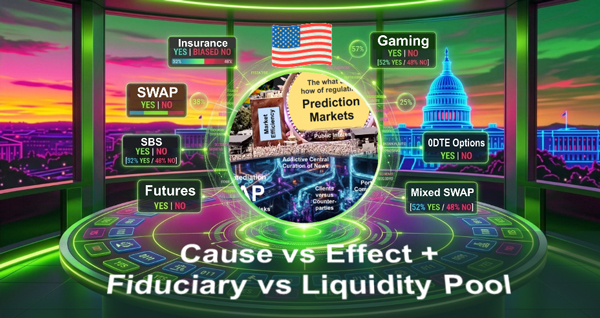
The significancy of determining of whether certain Event Contracts are swaps, Securities Based Swap (SBS), or mixed swaps, or types of instruments that fall within statutory exclusions from the “swap” definition, would affect whether a product may or may not be subjected to the Title VII clearing, margin, and prudential oversight alongside other Financial Stability Oversight Council (FSOC) members. While prudential regulators require comprehensive risk-tracking tools to safeguard financial stability, a Title VII classification introduces a much heavier compliance burden for markets and participants.
- Operational Friction: Mapping a $1 retail contract into legacy Swap Data Repository (SDR) or SBSDR fields via slow, XML-based protocols creates an expensive data-processing tax.
- The SEC Overextension: The SEC's “Event Contract Prong” errantly treats raw operational facts (e.g., factory counts or emissions) as security-based variables.
- Cause vs. Effect: Real-world operational inputs are broad economic commodity “causes,” not security-based valuational “effects”.
Exposure to a specific “cause” represents just one potential pathway to an event, serving as a sufficient condition alongside other independent factors that could lead to the same outcome. Witnessing the final “effect” confirms that the outcome is already present, meaning that at least one of these causal chains has been successfully finalized. Just because two things happen together does not mean one caused the other. They might both be caused by a third hidden event.
- I. The Exposure to Cause versus Effect (E2CvE) Framework
To eliminate duplicate policing, risk must be categorized by its true economic nature using three structural filters:
- The Operational Sorter (Settlement Mechanism Test): Evaluates settlement data sources. Contracts settling against raw, non-valuational facts are CFTC commodity swaps, while those settling against market appraisals are SEC SBS.
- The Legal Filter (Insulated Valuation Test): Requires the contract payout to be mathematically dependent on capital-market appraisals (e.g., stock tickers) to trigger SEC oversight.
- The Structural Gate (Operational Intent Test): (i) Trading venues with high-velocity bots generate a volatile “Valuation Mirage,” requiring SEC oversight. (ii) Pre-funded architectures function as passive parametric insurance pools under lean CFTC rules ® i.e., Routes products by operational vehicle.
Policy Makers should amend 7 U.S.C. § 1a(47)(B) by striking clause (v) and inserting a statutory Two-Part Bright-Line Test.

- II. The Enhanced Fiduciary Commodity Pool Operator (CPO)-Matchmaker Model
Since the US cannot simply adopt the EU/UK's Multilateral Trading Facility (MTF) model because of the Commodity Exchange Act (CEA) mandate to preserve the default waterfall model, policymakers should consider establishing a Safe Harbor to exempt 100% pre-funded CPO-Matchmaker model from traditional mutualized banking default funds – replacing manual paperwork with rigorous mathematical code audits of underlying smart contracts, liquidation scripts, and oracle price feeds to defend against flash-loan vulnerabilities.
We urge the Commissions to utilize their general exemptive and joint rulemaking authority under §4(c) of the CEA and §§13(n), 15F, and 36 of the Securities Exchange Act (SEA) of 1934 to codify an alternative compliance pathway:
- Absolute Asset Isolation: Every account functions as an independent, legally segregated “series cell” under CFTC Rule 4.20, meaning assets and wagers cannot touch or cross-collateralize.
- Double-Layered Fiduciary Protection: Operators owe a federal fiduciary duty under Part 4 of the CEA alongside state-level corporate duties, strictly protecting participants from the conflicts native to exchange architectures.
- Tax Simplification: Bypasses K-1 routing to automate earnings reporting via standard Form 1099-B templates.
- I. Structural Mechanics and Eliminating Systemic Risk
The CPO model registers a net-zero risk signature across the four core-metrics of prudential oversight:
- Eliminating Systemic Credit Risk: Leverage is programmatically impossible because contracts require 100% upfront pre-funding, rendering mutualized banking default funds obsolete.
- Eradicating the “Valuation Mirage” via Anti-Bot Policies: Direct Retail Clearing models are vulnerable to secret internal affiliate algorithmic trading bots that fabricate activity and widen spreads. The Enhanced CPO model mandates a ban on affiliate algorithmic bots to eliminate artificial volume noise and anchor price discovery to objective third-party oracles.
- Orderly Wind-Down & Asset Isolation: Client assets sit in a distinct trust separate from the operator’s capital, isolating cash from corporate creditors if the startup goes bankrupt.
- II. Streamlined Split-Ingestion Data Reporting
To satisfy the data harmonization goals of SEC File No. S7-2026-22, we propose a three-module reporting architecture built on cloud-native web protocols:
- Module 1 – The Transactional and Identity Layer (Split Model): Decouples market data from identities. Track 1 streams anonymous transaction tapes via compressed JSON payloads over a read-only WebSockets connection. Track 2 keeps customer identity data localized. Regulators pull identity packages via an Electronic Blue Sheet (EBS) gateway only when surveillance nodes flag an anomaly.
- Module 2 – Daily Solvency Verification: Solvency reporting completely bypasses platform metrics. An independent custodian bank pushes daily cash logs to the NFA WinJammer Portal via automated APIs.
- Module 3 – Streamlined Compression Reporting: Net-risk summary logs are pushed every 1 to 5 minutes to an SDR event bucket, cutting gross exposure logs by over 90% and clearing out blank fields.
- III. Concerted Surveillance and the Whistleblower Analogy
We strongly oppose the current CFTC proposal to force exchanges to independently gather employee and occupation data under §16.03(g), as it breaks the dual-tier architecture established under CFTC Rule 166.3 and Part 38 Core Principles. Alternative compliance oversight should update CFTC §40.11 and Part 38 to mandate a tiered surveillance architecture that establishes a concerted coordination framework between execution venues and client-facing brokers. Instead of relying on generic “data-in-motion” transfers under Part 16 – which create data granularity deficits and vulnerable cybersecurity honeypots – platforms should use a pull-based model under CFTC Rule 38.254. Under this framework, the exchange operates a Tier 1 Agentic AI layer to monitor anonymous trade data for anomalies, while client-facing brokers maintain a Tier 2 Audit Trail Hub semantic database to house customer identities and KYC/AML records under Part 1 rules.
This tiered architecture allows exchanges to summon localized participant identities and secure business communications when a Tier 1 automated surveillance node flags a specific symptom of market abuse. To comply with SEC Rule 17a-4 and FINRA Rule 3110 while permitting Bring Your Own Device (BYOD) cell phone use, broker-dealers use containerized work apps or eSIM carrier mirroring to isolate and record business data without violating privacy. This precision framework allows regulators to look beyond legacy volume metrics and deploy forensic simulation back-testing to reconstruct trade sequences, evaluate market-maker alignment, and flag onset signals of manipulation across interconnected networks.
Finally, policymakers can evaluate these cross-market mechanics through the lens of corporate whistleblower programs, as both frameworks leverage frontline intelligence to reduce data asymmetry and expose hidden malfeasance. To resolve the
“Insider Information Paradox” and prevent incentivized sabotage, the alternative compliance regime must enforce an Enforcement Safe Harbor. This policy permits expertise-driven analysis of fragmented public data, but legally bars corporate insiders from betting against their employers on prediction markets. Instead, it mandates that insiders would route sensitive tips through formal SEC and CFTC whistleblower channels, channeling true information into structured legal remedies rather than chaotic, anonymous market sell-offs. Download our full 60-page comment letter about SWAP at: https://www.databoiler.com/index_htm_files/DataBoiler%20CFTC%20SEC%2020260824.pdf