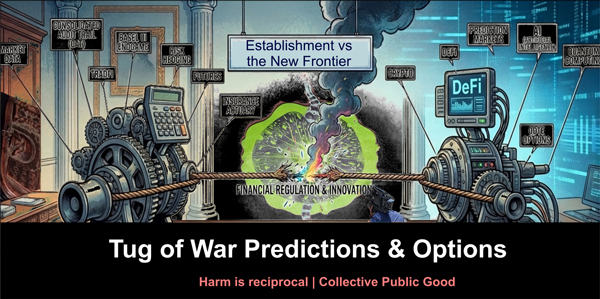
Convergence is a clash – an inevitable tug-of-war between different forces. While geopolitical war takes center stage, AI, Crypto, and other emerging technologies are rapidly developing new frontiers to challenge traditional ways of living. Per this legendary IEA Report, “Any analysis which predicts the outcomes of a given policy will throw light on its desirability… Harm is reciprocal…” Which arrangement would yield the highest net value, avoid greater harm, and minimize frictions/ transaction costs for society? What are the early indicators? How to directionally predict and evaluate different available options to consider not only the BestEx but BATNA, i.e. the most advantageous course of action if no agreement is reached.
Evolving or displaced: Hegemony and AI
Amid the controversies surrounding Realpolitik, the US pragmatic approach helps ensure survival of the fittest. The IMF-World Bank Spring Meetings’ agenda is not contemporary, off-focus, or lack concrete solutions to ease conflicts. Everybody knows without their saying about economic uncertainty and risks of high global debt. In an unconcerted world, touting old-school, slogan-based diplomacy regarding international cooperation, energy supplies, and ESG does not ease conflicts. Self-interest prevails over altruism when people are asked to contribute resources and take risks for the greater good.
Many worry about AI or the future taking our jobs. It is true: private investments that previously poured into SaaS is being disrupted by AI’s code-generation ability. But look, the piping to tokenize/ securitize, perfecting related valuations, and democratizing access to alternative investments are underway. The SEC and CFTC have proposed amendments to reduce private fund reporting burdens. In turn, more resources can be allocated to entrepreneurs to build toward this shared future.
Reskilling is uncomfortable, yet countless professional athletes, capital market traders, and those who were overstressed and forced into early retirement have experienced it. Now, this challenge is spreading to the wider population amidst multiple rounds of layoffs across sectors and government. The only way to revive one’s career is to learn, unlearn, and relearn – embracing the surprising usefulness of useless knowledge. While many are short sightedly looking to profit from the commercialization of AI applications, the greater opportunity lies in plugging into the ecosystem that contributes to the advancement of AI/ quantum computing.
Aggregation of Volumes and Mass Customization
Price-time priority is undermined by initial bias (Exchanges optimally restricted access to price information). Many choose to collaborate with the Haves for outsourced execution rather than compete, when regulators did not do enough to rectify the latency arms race. The SEC proposal to ban volume-based pricing tiers has been withdrawn. Success is defined by picking side and plugging-in with large ecosystems. We are thankful that the voice of critics was ultimately heard. Not only did the SEC approve another modified version of CAT NMS Plan in March to further slash wastage by $50-70 million, but the April’s concept release also incorporated our ideas – such as analyzing data directly at the sources – to overhaul the outdated design, address civil liberties and privacy concerns, and petition for changes to the funding model.
It is a tug-of-war where US banks ask for additional reliefs in Basel III endgame. Amid friction with the UK Bank of England, the FCA is weighing a move away from existing EU-derived rules for investment firms’ market risk capital requirements, aligning instead to the US “net risk” approach. Stablecoin issuers rather have no deals with policy makers unless they permit yield-bearing tokens. We recommend a “break-bulk exemption”, so small banks and credit unions can compete. Meanwhile, the higher-for-longer interest rate regime continues to pressure US recession trades. Rising stagflation risks and fractured bond-equity correlations are prompting investors to rethink classic hedges. Many are now actively seeking to insulate their portfolios from intensifying geopolitical shocks (e.g. currencies and trade wars). Line between trading and gambling is blurring when hard efforts in doing ordinary business have little to no payoff.
Serendipity is the ability to capitalize on the unexpected
The ability to predict the future drives productivity and economic growth. 0DTE Options now drive 59% of S&P 500 Index options (SPX) trading volume. When choosing between a 0DTE Protective Put and an Iron Condor the decision depends on whether one is hedging against a directional crash or seeking to offset the cost-of-waiting in a stagnant market. No doubt that the complexity of the Greeks (Gamma, Theta), Time Decay, and utilize high leverage is analogous to precision scalpels, i.e. may not be suitable for retail. Prediction Market (PM) is relatively cheaper and easier to navigate because of its breadth wide coverage of real-world outcomes and efficiency in aggregate information.
Let go of prejudice. Prediction Markets are NOT NOVEL. Intellectual groundwork was laid by Economists who viewed markets as information processors since the 1940s-1970s. The Federal Reserve Board found PM’s performance better than Surveys of Market Expectations for forecasting macroeconomic data. Entities of all sizes can use PMs to predict, gauge, and/or project how their innovative products, services, or business models would be perceived in a live environment. Related Economic works should commence everyone’s respect in advancing societal development.
Unlike securities markets defined by continuous price discovery, trading in PMs function as short-lived exposures to the “cause” while 0DTE Options provide exposure to the “effect.” The beauty of simultaneous hedging strategies is the decoupling of Event and Price Risk. Standard options disclosures deem insufficient to explain the all-or-nothing nature, illiquid, expiration timing, susceptibility to influence by a small group, etc. Disclaimer: Event contracts are not designed to track the underlying asset’s price movements. Rather, contract pricing reflects market-implied probabilities of specific outcomes, which may result in a basis risk or a lack of direct correlation with a participant’s underlying financial exposure.
Synthesizing Crowd Wisdom with Computational Power
Opposers cry fouls to speculative trading in PMs. Per this Whelan Paper, Favorite-longshot bias is the core problem that harms retail. Unconventional, or to some extent counter-intuitive, is – the empirical research suggests PM currently has too much friction. It starves out “healthy” speculators. Liquidity is a Catch-22, Makers widen spreads to protect against being “picked off”. High fee-to-contract-value ratio prevent arbitrageurs from engaging in price improvement, failing to reduce the “stupid tax” or “overpriced lottery ticket effect” created by market operator. It is a Volume versus Integrity Paradox.
We advocate for a Copyright Licensing mechanism to rebalance the “Information Tax”. This structure turns the zero-sum game into a Sovereign Information Hedging Utility (SIHU) aligning everyone’s “selfish” interests toward a “collective” public good. We hope more focus can be channeled toward the constructive fix of market designs (e.g. natural versus toxic liquidity, adverse selection, anti-masquerading, resolution mechanism, surveillance challenges, governance, stress and claw back, etc.) to make PMs a positive sum for risk hedging, market efficiency, growth, and financial stability.
Integrating intelligence about real-world probabilities enhances performance to manage uncertainty. It allows AI to move beyond deterministic “yes/no” outputs to more nuanced “shades of uncertainty,” making systems more robust in messy, real-world environments (noise handling, context awareness). The model requires less data to reach accuracy. Also, it is the “backbone” of quantum computing. AI models are now used to predict and correct “qubit noise.” Qubits exist in a superposition of states defined by probability amplitudes rather than fixed binary bits.
Consider what insurance actuaries do – dealing with probabilities of event outcomes. Insurance contracts and Prediction Markets/ 0DTE Options’ event contracts both compete and complement each other. 98% Ò 99.9% incremental improvement is better than 85% Ò 90% because it is 95% error reductions vs just 33%. It is a race to reduce unknown unknowns. The availability of superior insurance products will be driven by a shift from reactive to preventive models, where risks are mitigated before they occur. Amid insurance is expected to remain a necessity, Quantum and pre-cognitive AI will fundamentally transform the industry (e.g. Actuarial roles are evolving from “number crunchers” to strategic risk managers).
Stay tuned for our series of discussions on discerning between gaming and PMs (powers of two litmus test), applicability of certain CFTC’s CORE Principles, and the use of market ostracism (3 lines of defense) to deter bad actors/ foreign adversaries.

By Kelvin To, Founder and President of Data Boiler Technologies Data Boiler is a Pioneer in FinTech with patented inventions (US, Canada, Singapore, Japan, Australia, and 20 European countries) in signal processing, trade analytics, machine learning, time-lock cryptography, etc. We frequently comment on regulatory policy both domestically and abroad with over 12 years in business. A type C Member of the European Commission’s Data Expert Group + former committee of BITS (Bank Policy Institute). |