



E-invoice compliance isn’t a reactive, back-office task, it’s a strategic lever that can drive resilience and competitive advantage. But findings from the latest research from Basware, the global leader in Invoice Lifecycle Management, show a majority of US companies can’t scale without breaking rules.
According to The Compliance Wake-up Call, a global survey conducted by FT Longitude with support from Basware, more than 83% of 400 US finance leaders at companies with over $1BN in revenue polled say fragmented approaches and spreadsheets exposed their organizations to major risks, including frequent fines, fraudulent activity, and e-invoice rejections that are eroding margins and cash flow and stalling plans for growth.
“International trade is shifting toward standardized, government portals, and business growth depends on compliance readiness,” said Markus Hornburg, SVP, Global Compliance, Basware. “If you can’t be compliant, you can’t grow.”
Scale to Win
Basware’s research bears this out:
- Only one-third (33%) of executives say their organizations are highly effective at scaling compliance processes as their business grows.
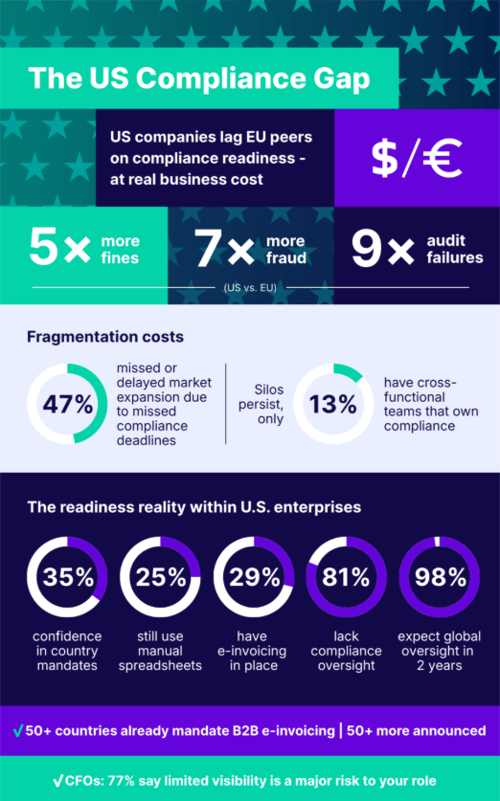
- Nearly one in two (47%) say they have struggled with market expansion or upkeep as a result.
Break Down Silos
It’s a process problem. At a vast majority of the companies represented in the Basware survey, compliance is handled in silos. Only 13% of US companies doing business globally have created a cross-functional team that owns compliance.
And this is exposing them to greater risk than their European peers, as they are:
- Five times more likely to frequently pay fines and penalties
- Seven times more likely to frequently experience fraudulent activity
- Almost nine times more likely to frequently discover non-compliance in tax audits
Embrace Digitization
Technology – or lack thereof - also plays a role. Modern compliance requires real-time data flows. Spreadsheets and patchwork automation cannot handle multi-country trade and e-invoicing. Yet this is what most companies still rely on. According to The Compliance Wake-up Call:
- 25% of companies still use spreadsheets
- 45% still rely on OCR/scanning
- Only 29% have fully embedded e-invoicing platforms, and
- Just 35% say they are highly confident in their ability to implement e-invoicing solutions that meet country-specific mandates.
US companies understand that technology can help them create better compliance strategies. Almost all of those who participated in the survey (96%) say that investing more in compliance technologies would save time and money in the long term.
Accept Short-Term Pain for Long-Term Gains
For companies with international growth ambitions, the time to fix these problems is now. In 2026, there will be new mandates in France, Belgium, and Poland that require all companies doing business within their borders to exchange invoices electronically. The UK is set to announce a detailed roadmap for its 2029 e-invoicing mandate, and another 50 countries are in the pipeline around the globe.
If US companies want to do business in these countries or expand into them, their compliance frameworks need to be ready. “The sooner you start preparing, the better,” says Tayla Stocks, Indirect Tax Manager at Deloitte Tax and Legal. “Ownership, roles, and responsibilities need to be organized now.”
And while there may be short term pain in doing so, Laurence Uzureau, CFO at global food supplier OSI Group, says the long-term gains are worth it. “From a business perspective, meeting compliance mandates is a must and quickly becomes table stakes. In some cases, they may add costs, especially in the short run, and disrupt how our businesses operate. E-invoicing in Europe is a good example of the hard work to setup in the short run, but it will undoubtedly bring efficiency that our finance team members will enjoy,” she said.
Plan Today for Tomorrow
While many mandates are not yet being strictly enforced, non-compliance will not be an option for long. The Basware report outlines five actions companies can take today to ensure they thrive in the new international compliance environment tomorrow:
- Think Globally, Act Locally - If your company has international aspirations, create centralized compliance processes and invest in resources that match country requirements.
- Plan for Future Expansion - Compliance is a critical part of sustainable business growth. Consider it in overall strategic discussions to make sure compliance processes support your company’s future direction.
- Embrace Digital - Use technology to help your organization stay up to date with new global requirements and scale processes to adapt quickly to regulations.
- Integrate Teams and Data - Align tax, procurement, accounts payable, IT and legal teams to build strategies that can cope with an evolving regulatory environment and integrate data to give them full oversight.
- Standardize to Optimize - Heavy customization is complex and unnecessary. Establish common standards across mandates and align the underlying data requirements to make compliance and global expansion manageable.
“As global regulations evolve, compliance is becoming a hallmark of business maturity,” Hornburg said.
“As global regulations evolve, compliance is becoming a hallmark of business maturity,” Hornburg said. “With new mandates on the horizon, CFOs must move compliance to the top of their agendas to avoid stunted growth.”
To unlock additional insights, click here.

