August 2026 Chicago Report™
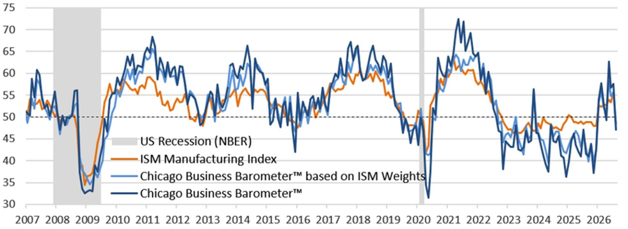
The Chicago Business Barometer™, produced with MNI, dropped 10.5 points to 47.1 in August. The Barometer is below the neutral 50 level for the first time since April, and at its lowest since December.
The fall was driven by declines in New Orders, Order Backlogs, Production and Supplier Deliveries. A small rise in Employment provided some positive offset.
New Orders contracted sharply, slipping 15.4 points, but still above April’s low. The share of respondents reporting increased orders declined sharply.
Order Backlogs softened 12.1 points, remaining below the neutral mark and now at its lowest since last November.
Production declined 8.8 points for its first contractionary reading since last December, and the lowest level since last November. Some respondents noted slowdown in customer demand.
Supplier Deliveries eased 2.6 points, but remained in expansion for the nineteenth consecutive month. The proportion of respondents reporting faster deliveries declined slightly, as did the share reporting slower deliveries.
Employment provided a positive offset, rising 4.3 points to its first expansionary reading in five months, although only marginally so.
Inventories retreated 14.0 points, returning to contraction after one month above 50. The share of respondents reporting larger inventories fell sharply.
Prices Paid grew 3.8 points to the highest level since February 2022. Some respondents cited higher metal costs in August.
The survey ran from August 1 to August 12.
In August, the Chicago ReportTM also asked firms “Outside of supply chain challenges, what do you see as the biggest upside and downside risks facing your business over the next six months?”
- Respondents identified technology and AI, continued opportunities for procurement cost savings, and growth in new markets as key upside risks.
- On the downside, respondents cited material shortages and supply disruptions, ongoing geopolitical and tariff uncertainty, and elevated interest rates as key risks.
- More broadly, respondents emphasized that managing elevated costs will be important in the coming months.