
While we at Data Boiler share the Commission’s desire to eliminate the multi-billion-dollar technology and data-fee burden imposed by rent-seeking, low-volume venues, a complete rescission of Order Protection Rules (OPR) will create an unstable, highly fragmented market structure. Removing these intermarket price boundaries triggers a structural “Race to the Bottom,” akin to Gresham's Law of Microstructure, where bad market environments drive out good displayed liquidity.
Without a legal mandate guaranteeing price protection, the core economic incentive for market participants to display visible limit orders on lit exchanges severely degrades. Traders will actively pull their public quotes and retreat into dark pools, single-dealer platforms, and bilateral silos, leading to a dramatic hollowing out of visible market depth. The consequences of this total structural dismantling include:
Severe Market Fragmentation: Liquidity will fracture across dozens of unlinked, disconnected trading “echo chambers” that stream conflicting versions of the BBO.
NBBO Degradation: Public spreads will widen drastically, and the refresh rate and integrity of the NBBO will collapse like Europe, turning the official tape into an inaccurate, lagging reflection of actual supply and demand.
Destruction of Retail Price Discovery: Uninformed retail order flow will be systematically cherry-picked, captured, and walled off within private bilateral silos using weaponized price discrimination, starving public exchanges of diverse volume.
Disrupt critical Cross-Asset Derivative Hedging: The breakdown of the underlying equity reference price will break the real-time linkages necessary for options market makers to clear risk, forcing a wider, systemic spread expansion across related derivative products.
NOTE: By legally protecting displayed quotes, the OPR in tandem with the SIP – which supposed to be a light weight close substitute for exchanges’ proprietary data feeds – acts as a powerful Advertising function that projects a transparent, deeply liquid market to globally reinforce investor confidence, representing the most critical mechanism driving the U.S. market's competitive advantage over foreign jurisdictions.
The Fatal Flaws of Complete Rescission and the Privatization of Liquidity
A complete elimination of intermarket price protection will cause institutional volume to abandon public continuous trading hours, migrating into private, unlinked single-dealer “echo chambers” to avoid adverse selection. This shift will hollow out the public Central Limit Order Book, expand the Equity Risk Premium for corporate issuers, and introduce severe tracking errors of Exchange Traded Products. While periodic auctions at lit exchanges and Alternative Trading Systems (ATSs) will increase, completely rescinding OPR strips away the synchronization between the Central Limit Order Book (CLOB) and auctions, paving the way for cheap, highly profitable, and uninhibited cross-mechanism arbitrage. Furthermore, executing continuous global sessions without intermarket boundaries would result in erratic, high volatile public books that thin out unevenly during stress. This creates a high risk of micro-flash crashes on isolated secondary venues while the primary exchange trades normally, heightening overarching systemic liquidity risk.
The Commission’s Analytical Failure Regarding Multi-Asset Linkages and Delta-Hedge Slippage
The proposal erroneously treats the US equity market as an isolated ecosystem, completely ignoring the profound downstream effects that the rescission of Rules 611 and 610(e) will have on the listed options market. While the Commission hosted an Options Market Structure Roundtable in April 2026, that discussion stuck entirely to isolated derivatives debates – such as strike proliferation, retail auction mechanics, and specialist allocations – completely failing to anticipate the cross-asset execution and hedging dislocations that this equity proposal will mandate.
Options market makers do not quote derivatives in a vacuum; they survive by instantly delta-hedging their risk using the underlying NMS stocks. If the Commission completely repeals equity price protections while keeping the Options Order Protection NMS Plan active, a severe market asymmetry is born. Options market makers will face uncompensated timing lags and execution slippage on their equity hedging legs as the underlying market fragments into unlinked books.
To absorb this unhedged equity execution risk, options market makers will be forced to drastically widen their options quotes on strictly protected options exchanges. By failing to model the delta-hedge timing loop, this proposal if adopted “as-is”, it will drive up transaction costs and widen synthetic spreads, increase frictions and predatory cross-asset arbitrage, as well as wholesaler internalization arbitrage harming retail, pension and mutual funds.
Heightened Disputes and the Weaponization of Regulatory Data
Streaming crossed or locked quotes fractures the regulatory framework and strips the NBBO of its legal teeth, shifting the burden of proof to broker-dealers under FINRA Rule 5310. Firms are forced into a bureaucratic compliance exercise to justify routing designs through rigid, expensive “Material Markets” documentation, creating an artificial barrier to entry that suppresses smaller, innovative firms. Furthermore, sequence drift in the noisy Consolidated Audit Trail (CAT) database can perversely flip the timing of rapid-fire adjustments and cancellations in enforcement. This structural distortion creates false signals of spoofing or quote stuffing, running a high risk that flawed data will be weaponized to penalize blameless market participants and chill retail volume.
The Structural Superiority of the Venue Trading Volume Threshold
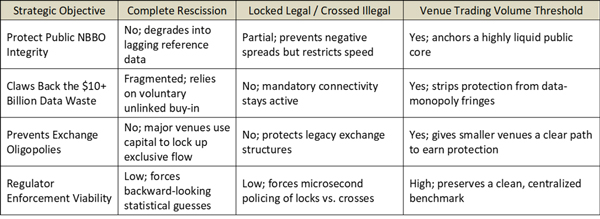
Our Recommendation
Instead of a complete repeal, the Commission should adopt the Venue Trading Volume Threshold for Protected Quotes alternative. When paired with an industry-led Copyright Licensing Framework, this surgical alternative achieves the SEC’s cost-reduction goals without market chaos. It sharpens public price discovery, supports a 23x5 global trading architecture, eliminates predatory maker-taker rebate games, and systematically protects the broader financial ecosystem. Setting a rolling market-share threshold (e.g., 1% of aggregate NMS volume) instantly strips protected status from illiquid, fringe exchanges. This legally allows broker-dealers to safely disconnect from rent-seeking platforms, freeing up billions in capital currently wasted on exchange data rents, access fee rebates, and payment for order flow (PFOF).
Stripping protection from minor venues allows them to compete as “streaming platforms” that pay “performance royalties” to “content creators,” eliminating toxic rebate games and optimizing clearinghouse risk management. This copyright framework realigns $10+ billion in wasted data rents into a robust clearinghouse Default Insurance Fund, monetizes historical transaction sequences via flat-fee “Sound Library” subscriptions, and deploys Time-Lock Encryption to neutralize latency arbitrage. Furthermore, a Liability Pass-Through Architecture holds both brokers and platforms accountable for algorithmic glitches. If a member defaults, the clearinghouse can seize and lease out their algorithmic catalog via an Emergency Auction Engine, recouping losses without dumping securities inventory or triggering artificial market panics.
We urge the SEC to implement a 12-month pilot program establishing a 1% rolling average daily volume threshold for protected quotes, applied initially to a limited subset of NMS stocks to serve as a safe, data-driven transition runway. This preserves the absolute integrity of public price discovery, prevents severe cross-asset dislocations, and protects the cross-asset delta-hedging pipeline, while successfully modernizing the US National Market System into an intellectual property-driven global powerhouse. Download our full 33-page comment letter to the SEC at: https://www.DataBoiler.com/index_htm_files/DataBoiler%20SEC%20OPR%2020260817.pdf
 Data Boiler is a Pioneer in FinTech with patented inventions (US, Canada, Singapore, Japan, Australia, and 20 European countries) in signal processing, trade analytics, machine learning, time-lock cryptography, etc. We frequently comment on regulatory policy both domestically and abroad with over 12 years in business. A type C Member of the European Commission’s Data Expert Group + former committee of BITS (Bank Policy Institute). Data Boiler is a Pioneer in FinTech with patented inventions (US, Canada, Singapore, Japan, Australia, and 20 European countries) in signal processing, trade analytics, machine learning, time-lock cryptography, etc. We frequently comment on regulatory policy both domestically and abroad with over 12 years in business. A type C Member of the European Commission’s Data Expert Group + former committee of BITS (Bank Policy Institute). |