ASIC has, for the first time, published detailed data and insights into how voluntary administrations (VAs) and deeds of company arrangement (DOCAs) are operating in practice, providing a clearer picture of when the processes are being used, the outcomes being produced, and the types of companies most likely to benefit.
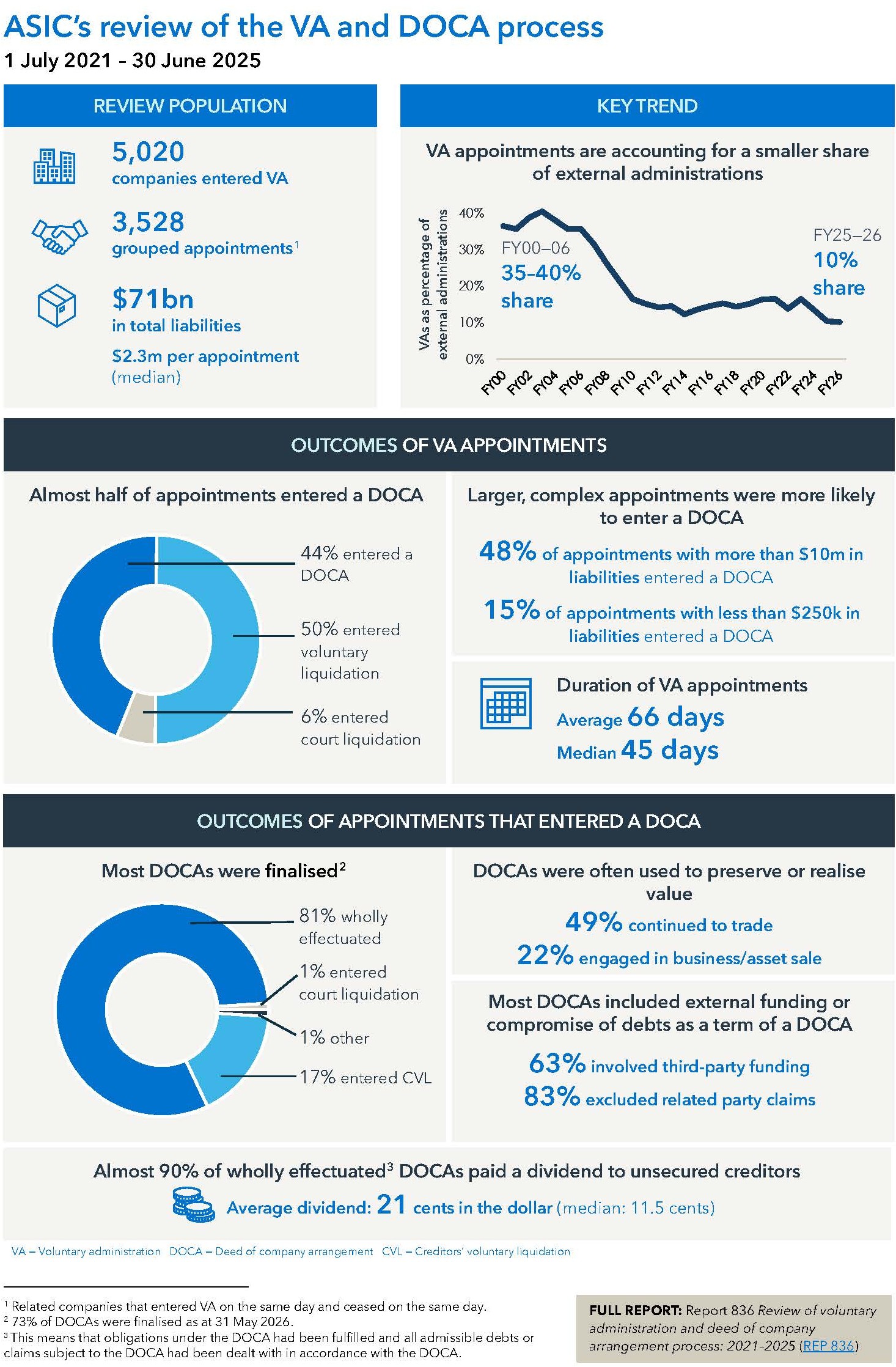
The Report 836 Review of voluntary administration and deed of company arrangement process: 2021-25 (REP 836) looked at 3,528 grouped appointments (including 5,020 companies) entering VA between 1 July 2021 and 30 June 2025.
ASIC Commissioner Kate O’Rourke said, ‘The review provides a stronger evidence base for understanding how voluntary administrations and deeds of company arrangement are operating in practice.
‘This is the first time ASIC has published this level of detail on voluntary administrations and deeds of company arrangement.
‘The data shows voluntary administrations and deeds of company arrangement remain an important restructuring tool, particularly for larger and more complex companies, where it can support a broader range of outcomes than an immediate winding up.’
Insights from ASIC’s review
The review found larger and more complex appointments were more likely to result in a DOCA.
Around half of appointments that proceeded to a second creditors’ meeting included a DOCA proposal. Of those, 87% resulted in creditors accepting the proposal, representing around 44% of overall voluntary administrations.
Appointments involving companies with more than $10 million in liabilities were more likely to result in an approved DOCA, with around 48.3% of those appointments resulting in a DOCA. This compared with just 15.4% for appointments involving companies with $1 to $250,000 in liabilities.
Commissioner O’Rourke said the findings show DOCAs are being used for a range of commercial purposes.
‘Deeds of company arrangement can support different outcomes depending on the circumstances of the company. They may allow the company’s business to continue trading, facilitate the sale of the business or assets, or provide a mechanism for creditor claims to be compromised,’ Ms O’Rourke said.
‘This is important because voluntary administration is intended to give an insolvent company, or as much of its business as possible, an opportunity to continue where that is viable, or otherwise to produce a better return for creditors than an immediate winding up.’
Nearly half of approved DOCAs (730 of 1,500, or 49%) involved the company’s business continuing to trade after the deed was executed, reflecting the role the process can play in supporting business rescue where it is viable.
For smaller businesses, the review found the VA and DOCA process was less likely to result in a DOCA.
Commissioner O’Rourke said smaller companies may have other insolvency pathways available.
‘For smaller businesses, other pathways such as small business restructuring may be more efficient and cost effective, depending on the company’s circumstances,’ Ms O’Rourke said.
‘Less than one-third of smaller appointments, with liabilities of less than $1 million, resulted in a deed of company arrangement proposal being approved. Most of these appointments resulted in liquidation with no deed of company arrangement proposal being put to creditors.’
ASIC publishes first data pack on insolvency
The review forms part of ASIC’s ongoing work to make available high-quality and granular data on insolvency and insolvency processes.
Alongside the report, ASIC has made available a supporting data pack, REP 836 Data pack. The data pack provides more detailed aggregate data and allows users to filter by characteristics of interest, including company industry, size and appointment outcomes.
The data pack is intended to help registered liquidators, directors, creditors and other stakeholders to better understand how the VA and DOCA process is being used.
This report and data pack build on ASIC’s previous work to provide greater insight into how Australia’s insolvency system is working, including our 2024 review of simplified liquidations (24-175MR) and a 2025 review of the small business restructuring process (25-111MR).
Downloads
- Report 836 Review of voluntary administration and deed of company arrangement process: 2021–2025 (REP 836)
- REP 836 Data pack
- REP 836 infographic: ASIC's review of the voluntary administration and deed of company arrangement process – 1 July 2021 – 30 June 2025