Australia’s compulsory sustainability reporting regime, which commenced in 2025, aims to improve the quality, consistency and comparability of climate-related financial disclosures.
Below, we share our observations on the first sustainability reports prepared under Chapter 2M of the Corporations Act 2001 (Corporations Act). In doing so, we aim to assist other reporting entities as they approach the 30 June 2026 reporting season.
ASIC welcomes these first sustainability reports and acknowledges the significant effort put in by the preparers.
Sustainability reports from the largest entities
The new obligations are being phased in across three groups, with an entity’s group determined in part by its size. The entities in Group 1 are required to prepare sustainability reports for financial years commencing on or after 1 January 2025. Some of the Group 1 entities with financial years ending 31 December 2025 have now lodged their reports with us.
The observations in this article are based on our review of a subset of these first reports.
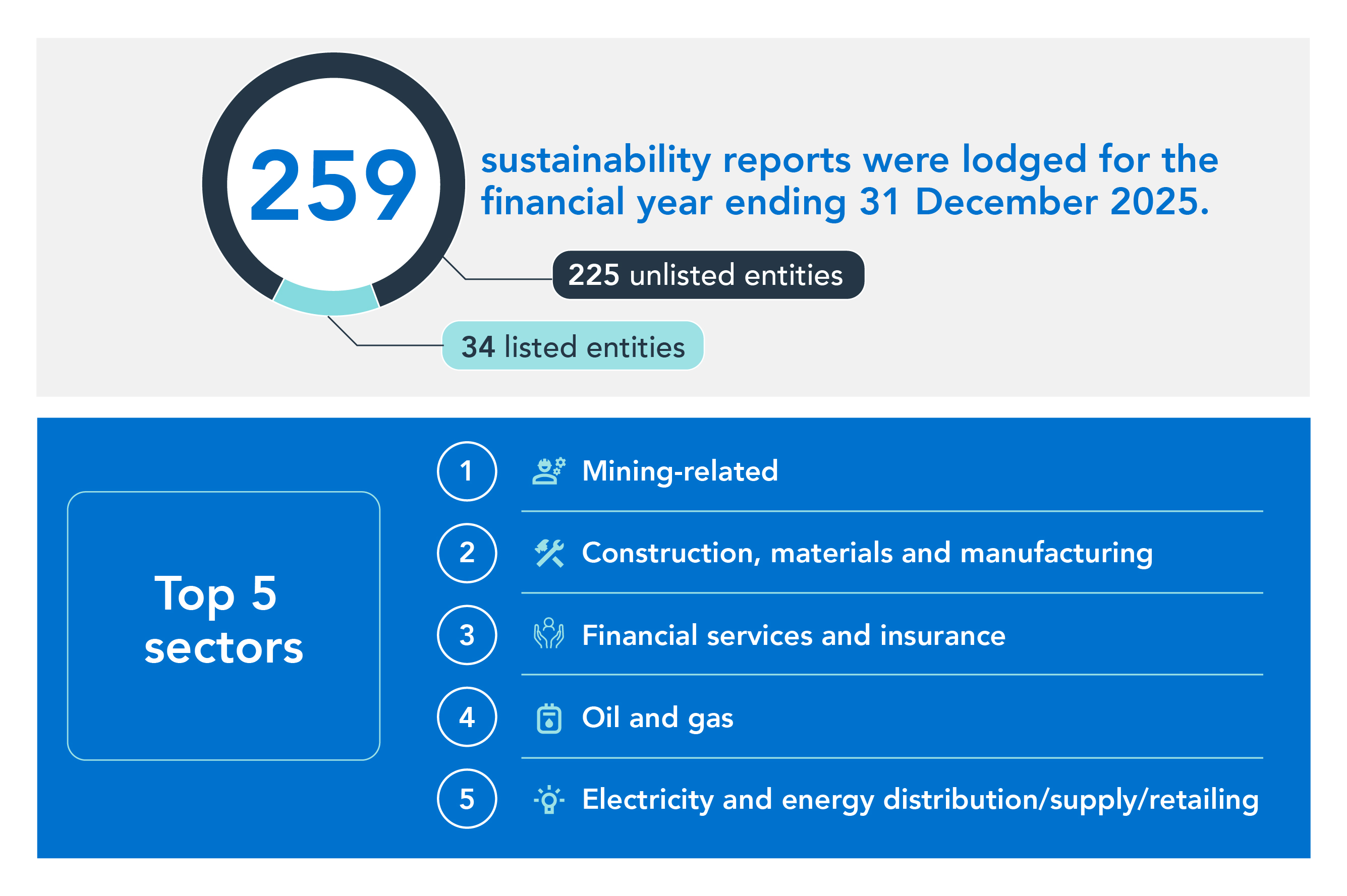
Figure 1 sets out an overview of the total number of sustainability reports lodged with ASIC as of 6 May 2026.
Figure 1. Overview of lodged sustainability reports
What we observed
Our review of sustainability reports focused on whether users are being provided with high-quality and decision-useful information that complies with the Corporations Act and AASB S2 Climate-related Disclosures.
In general, we have seen an increase in the quantity and quality of climate-related financial information in the market compared to previous voluntary climate-related disclosures. Standardised requirements are driving more consistency and comparability. We particularly commend reports that use tables, diagrams and other visual aids to present information.
However, we have identified opportunities to strengthen the quality of reporting, and we encourage entities to consider the following when preparing reports:
- Disclaimers that conflict with the statutory framework and objectives of Chapter 2M sustainability reporting may confuse or mislead and are not permitted to be used.
- The ‘reasonable and supportable’ information available to entities to identify climate-related risks includes information about ‘past events, current conditions and forecast future conditions.’
- Reports should provide clear, effective and proximate disclosure of relevant judgements, assumptions and areas of measurement uncertainty.
- The disclosure of additional climate-related information must not obscure material climate-related financial information.
- When cross-referencing information outside the sustainability report, entities must ensure they meet disclosure requirements.
- When determining whether an entity has a ‘climate-related target’, entities are reminded that the definition of ‘climate-related targets’ in AASB S2 extends to targets that the entity is required to meet by law or regulation. This includes greenhouse gas emissions targets such as the Safeguard Mechanism.
Next steps
Our review of 31 December 2025 sustainability reports will continue over the coming months. As part of this work, we may engage with reporting entities about their disclosures. Final observations from our reviews will be published in the second half of 2026.
ASIC’s wider body of work on sustainability, financial reporting and audit is described in our recent media release (see 26-098MR). We will also participate in the Australian Government’s consultation on reforms to reduce burden while maintaining core sustainability reporting requirements, that was announced in the Budget.
Early observations
| Observation | Further detail | Reference |
|---|---|---|
|
Reporting entities are not permitted to use disclaimers that conflict with the statutory framework and objectives of Ch 2M sustainability reporting as this may confuse, or at worst, mislead users of the report. |
We identified some disclaimers – either in, or proximate to, the sustainability report – that indicated users should not rely on the information contained in the sustainability report to make investment decisions, or that stated the entity took no responsibility for the accuracy or completeness of certain information. |
See, by analogy, ASIC policy at RG 228 at Table 3 and RG 111.123 -124. |
|
Reporting entities should be mindful that the ‘reasonable and supportable’ information available to them to identify climate-related risks includes information about ‘past events, current conditions and forecast future conditions’. |
We identified instances where, although assets and/or operations of reporting entities were previously disclosed as being financially impacted by extreme weather events in prior financial years (based on prior year financial reports and/or information announced to ASX), entities had not identified, or had not disclosed information about, similar risks impacting prospects over the short, medium or long term (or any related risk mitigation activities). |
Paragraph B9 of Appendix B of AASB S2 |
|
Reporting entities should ensure that the disclosure of judgements, assumptions and areas of measurement uncertainty are clear, effective and proximate. |
While we saw some instances of entities disclosing their judgements, we also saw instances where users would be required to draw their own conclusions about why information was included or disclosed in a particular way. For example, in relation to how the entity had applied the proportionality mechanisms in S2. Clear disclosure of assumptions and sources of estimation uncertainty supports users to understand the basis for forward-looking information. |
Paragraphs 74 – 81and D24 of Appendix D of AASB S2 RG 280.110 and RG 280.83 |
|
Reporting entities must ensure that the disclosure of additional climate-related information does not obscure the material climate-related financial information that must be disclosed under AASB S2. |
We identified instances where material information in the sustainability report was not clearly distinguishable from additional, voluntary climate-related financial information. While the inclusion of additional climate-related information that is not specifically required by AASB S2 may be necessary to ensure the fair presentation of the sustainability report, including additional climate-related information beyond this may pose the risk of obscuring material information. Index tables can be useful for setting out the location of information contained within the sustainability report. |
Paragraphs 15 (b), 62 and B27 of Appendix D of AASB S2 (fair presentation) RG 280. 92 - 94 |
|
Reporting entities should ensure that cross-referencing meets the requirements in AASB S2 and ASIC guidance in RG 280. Where a reporting entity cross-references another report prepared by the reporting entity, we strongly encourage the reporting entity to lodge that other report with its sustainability report (if it has not already been lodged with ASIC). |
We identified instances of reporting entities not meeting cross-referencing requirements. For example, cross-referencing information contained on websites or in reports that were not published by the entity, or entities failing to precisely specify the part of the other report that was to be incorporated. According to the requirements, a sustainability report can only cross-reference to another report published by the entity if it is available on the same terms and at the same time as the sustainability report. In addition, a cross-reference must refer to a precisely specified part of the other report. |
Paragraphs 63 and B45 – B47 of Appendix D of AASB S2 RG 280.86 - 88 |
|
Reporting entities should carefully consider whether they have a ‘climate-related target,’ noting that the definition of ‘climate-related targets’ in AASB S2 extends to targets the entity is required to meet by law or regulation, including greenhouse gas emissions targets (such as the Safeguard Mechanism). |
We observed varied approaches to the 'climate-related targets’ disclosure requirements, particularly how an entity determines what constitutes a climate-related target for the purpose of AASB S2. Under AASB S2, climate-related targets are the ‘quantitative and qualitative climate-related targets an entity has set to monitor progress towards achieving its strategic goals, and any targets it is required to meet by law or regulation, including any greenhouse gas emissions targets’. We observed different approaches applied to the assessment of targets required to be met ‘under law or regulation’ (e.g. the Safeguard Mechanism). |
Paragraphs 33 -37 of AASB S2 |
Note: These early observations are based on a desktop review of a sample of sustainability reports lodged by listed entities. They have been provided to assist entities and advisors as they prepare sustainability reports for the financial year ending 30 June 2026. Final observations will be published in the second half of 2026.