1. Can the Market Run Safely 24x7?
The transition of US capital markets to a continuous 23 to “24-hour” trading cycle is NOT a shift towards uniform, always-on symmetry. Instead, regulators and market infrastructure providers have engineered a deliberate two-tier framework. By maintaining the traditional 9:30 am - 4:00 pm Eastern Time (ET) window (Tier 1 Core Daytime), it commands deep institutional liquidity and provides the static 4:00 PM closing anchor used for portfolio valuations, options expirations, and Value-at-Risk (VaR) clearinghouse models. The Tier 2 Extended Overnight operation offers continuous international price discovery and convenience, but is structurally subordinated to the daytime session’s closing price.
This safety boundary is enforced by a temporary 20% Limit-Up Limit-Down overnight price band that programmatically rejects orders outside the corridor rather than triggering market-wide halts, ensuring overnight volatility cannot outrun clearinghouse margin models. However, a critical safety blind spot exists because the public SIP is legally prohibited from aggregating non-exchange ATS quotes overnight. This forces overnight liquidity into isolated private pools running on proprietary price collars, allowing a stock to be locked at a ceiling on one ATS while actively trading at a different price on another. True market-wide safety cannot be guaranteed until a unified overnight mechanism links these fragmented pools of capital.
2. Can It Run Resiliently Without Downtime?
Current financial infrastructure is highly vulnerable without its traditional nightly reset windows, and achieving seamless resiliency requires an extensive overhaul of core systems. Overnight trading potentially could generate massive message volumes that will cause traditional 32-bit tracking numbers to overflow and crash downstream processors mid-session, forcing an industry-wide migration to 64-bit integer tracking fields. While major exchanges have upgraded their systems, smaller brokers, dark pools and OTC platforms face an impending technical cliff before the December 2026 synchronization deadline.
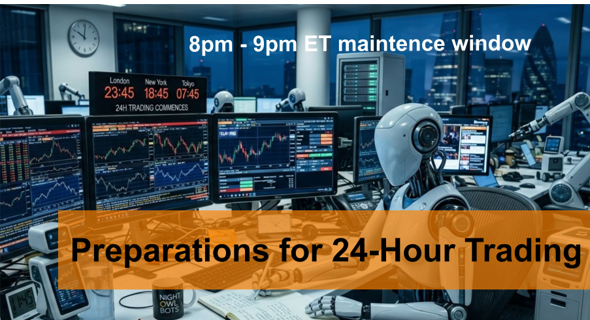
To prevent systemic data bloat, the market requires a mandatory, synchronized one-hour daily pause from 8 pm to 9 pm ET for matching engines to go dark, clear memory caches, and programmatically advance trade-date metadata. Furthermore, matching transactions over weekends when central bank payment rails (Fedwire and NSS) are closed creates an uncollateralized credit vacuum. To prevent hidden insolvencies, clearing firms should either demand massive pre-funded capital buffers from their member firms or bypass central bank hours entirely by migrating to private, 24/7 Distributed Ledger Technology collateral platforms to transfer tokenized US Treasuries peer-to-peer.
3. What will Continuous Trading do to Liquidity, Investor Protection, and Market Structure?
Continuous trading structurally bifurcates the financial landscape into deep daytime cycles and highly volatile overnight windows where roughly 90% to 95% of institutional volume remains anchored to the daytime session. This creates an “Overnight Paradox”: while total volume at 2 am ET is exceptionally low, the volatility risk of order bursts is extremely high because thin order books create “liquidity holes” where prices skip violently. To protect their balance sheets without a derivatives safety net, market makers automatically widen their spreads, penalizing retail investors with an “Illiquidity Tax.” This environment alters market structure by driving volume away from lit exchanges and into private SDPs and internalizing dark pools, which operate as closed-loop “Echo Chambers” utilizing custom proprietary pricing models.
Investor protection is severely compromised by the current operational disconnect where market surveillance and volatility interruptions function as two completely separate silos. Volatility engines operate on blind, reactive mathematics that can treat predatory algorithmic manipulation exactly like legitimate institutional order flow, while surveillance teams rely on post-trade forensic datasets on a T+1 basis (T+5 regulatory access for the opaqued and broken CAT). This lag allows manipulative algorithms to systematically weaponize “Phantom Halts” to lock up thin overnight books, utilizing the pause to clear risk or capture arbitrage profits on unlinked venues before human compliance teams can react.
4. What Regulatory Actions Should Follow?
To secure the ecosystem, regulators must mandate a transition away from post-trade forensic queues toward interconnected, real-time inline surveillance that populates compliance dashboards before volatility auctions conclude. Regulators should ban standard “Stop-Market” and “Market Orders” overnight, enforcing the use of Limit or Stop-Limit orders to prevent stop-loss fills in thin liquidity holes from triggering catastrophic, automated broker liquidation cascades.
To stop overnight shocks from mutating into systemic contagions, the SEC and CFTC must enforce cross-asset symmetrical halts, automatically broadcasting lock packets to clamp cash equity price corridors the moment a correlated index future on CME Globex, for example, breaches a volatility threshold. Finally, instead of draining market liquidity through punitive margin collections like the Options Clearing Corporation’s Intraday Risk Charge, the commissions should implement a centralized Copyright Licensing Mechanism. By transforming current wastage on toxic exchange data rents and payment for order flow into performance royalties, clearinghouses can build a robust, non-squeezed $10+ billion cash cushion to address the rising cost of clearing member defaults and the risk of systemic flash crash. In turn, preserving the US prominent position.
Download our full 24-page comment letter to the SEC at: https://www.databoiler.com/index_htm_files/DataBoiler%20SEC%2024H%2020260917.pdf
 |
Data Boiler is a Pioneer in FinTech with patented inventions (US, Canada, Singapore, Japan, Australia, and 20 European countries) in signal processing, trade analytics, machine learning, time-lock cryptography, etc. We frequently comment on regulatory policy both domestically and abroad with over 13 years in business. A type C Member of the European Commission’s Data Expert Group + former committee of BITS (Bank Policy Institute). |